 PassportPhotoSizes
Can You Take Your Own Passport Photo at Home?
By PassportPhotoSizes Editorial · Reviewed · 3 min read
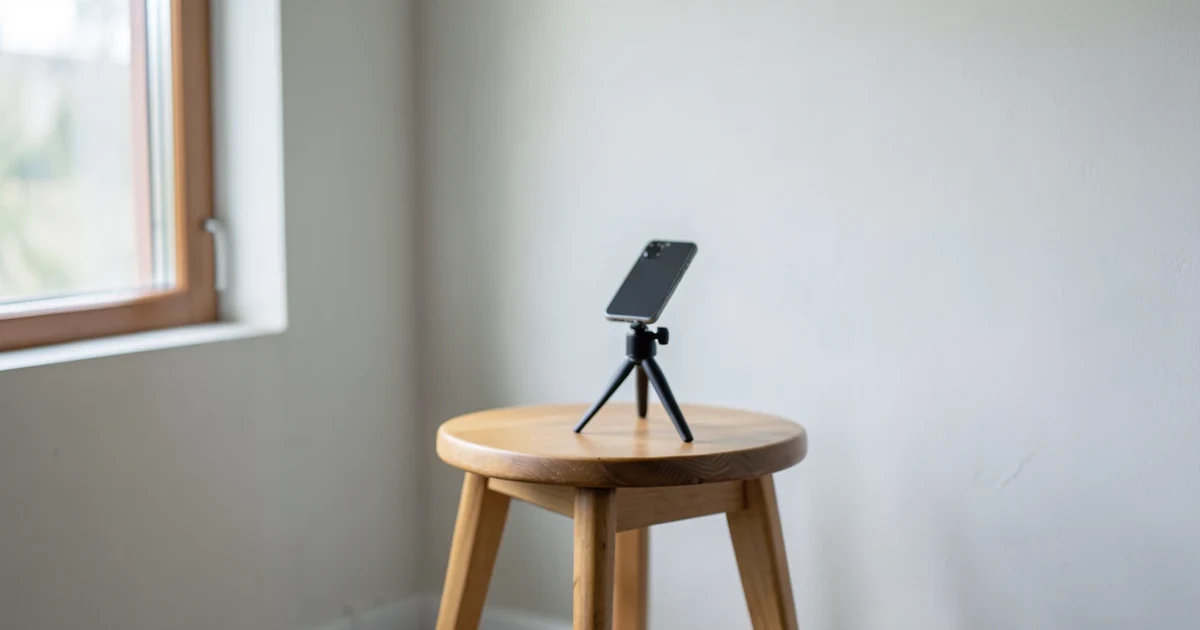
Yes, and no country requires otherwise. The rules govern the image, not who produced it, and a modern phone exceeds the resolution any of them ask for.
What catches people is not equipment. It is five specific things, and four of them are free to fix.
1. Distance, not zoom
Standing too close is the most common technical failure and it produces a photo that looks subtly wrong without anyone being able to say why. A lens close to a face enlarges the nose and narrows the ears — the same effect that makes selfies unflattering — and biometric systems are measuring exactly those proportions.
Stand 1.5 to 2 metres away and crop in afterwards. If your phone has a 2x or 3x lens, use it from that distance rather than the wide lens from close up.
This is also why a self-taken photo at arm's length rarely passes, regardless of how well everything else is done.
2. The background
It must be plain, evenly lit, and the right colour for the country — which is not always white. Off-white and light grey are specified in several places, and a few require a distinctly light blue.
- A plain wall works. A white bedsheet works if it is pulled taut and has no creases.
- Shadows on the background are the failure, not the background itself. Standing 50 cm or more away from the wall removes almost all of them.
- No texture, no pattern, no furniture edges, no door frames.
3. Lighting
Even, front-on, no shadows on the face or behind it.
- Face a window on an overcast day. This one condition produces better results than most home lighting setups.
- Do not use the on-camera flash. It produces a hard shadow behind the head and hot spots on the forehead and nose.
- Do not stand under a ceiling light, which shadows the eye sockets.
- Two lamps at 45 degrees either side, if you are doing it indoors at night.
4. Head height
The specification most people never read, and the one that fails photos that are otherwise perfect.
The frame size is easy to look up and easy to hit. The proportion of the frame the head must occupy is neither, because it is given in millimetres against a print size — the US wants 25–35 mm of head inside a 51 mm square, the UK 29–34 mm and Schengen 32–36 mm inside a 45 mm frame.
Get the frame right and the head wrong and it still comes back. The measurement runs from the bottom of the chin to the top of the head — the top of the hair for the US, the natural top of the head for Canada and ICAO-based rules — not to the shoulders, and not from the forehead. There must also be visible clearance above the hair, which cropping by eye almost always loses.
5. Expression and eyes
Neutral, mouth closed, both eyes open and clearly visible, looking straight at the camera.
- No smiling. A slight natural expression is tolerated in some countries; teeth are not.
- No hair across the eyes.
- No glasses at all in the United States, prohibited since 2016. Allowed elsewhere with conditions.
What you still need
A way to get the crop right. Frame dimensions and head height are both specified precisely, and eyeballing them is the last remaining failure point once the photograph itself is good.
The passport photo tool crops to the exact specification for any of thirty countries, with the head-height guides overlaid, and it runs in the browser — the photo is not uploaded anywhere.
Then check the requirements for your specific country, because they differ more than people expect: passport photo size by country.
Where home photos genuinely fail
Two cases are worth being honest about.
Very young children. Getting a neutral expression, open eyes, a plain background and no supporting hands visible is genuinely hard, and the rules are relaxed in specific ways that are easy to get wrong.
Some in-person applications where a photo is taken on the spot regardless — several countries' renewal processes work this way, and a home photo is not part of it.
Everywhere else, a phone, a window and a plain wall is the whole requirement. The reasons applications come back are set out in why passport photos get rejected, and the equipment is not among them.
Countries referenced
Keep reading
- Glasses in Passport Photos: Banned in the US, Conditional ElsewhereThe United States prohibited glasses entirely in 2016. Most other countries allow them, with conditions that catch people out.
- Can You Smile in a Passport Photo?A neutral expression with the mouth closed is required almost everywhere, and the reason is measurement rather than solemnity.
- Printing a Passport Photo at CVS, Walgreens or HomeYou can print your own photo at any pharmacy kiosk for a fraction of their passport service price — as long as you set the print size yourself.